
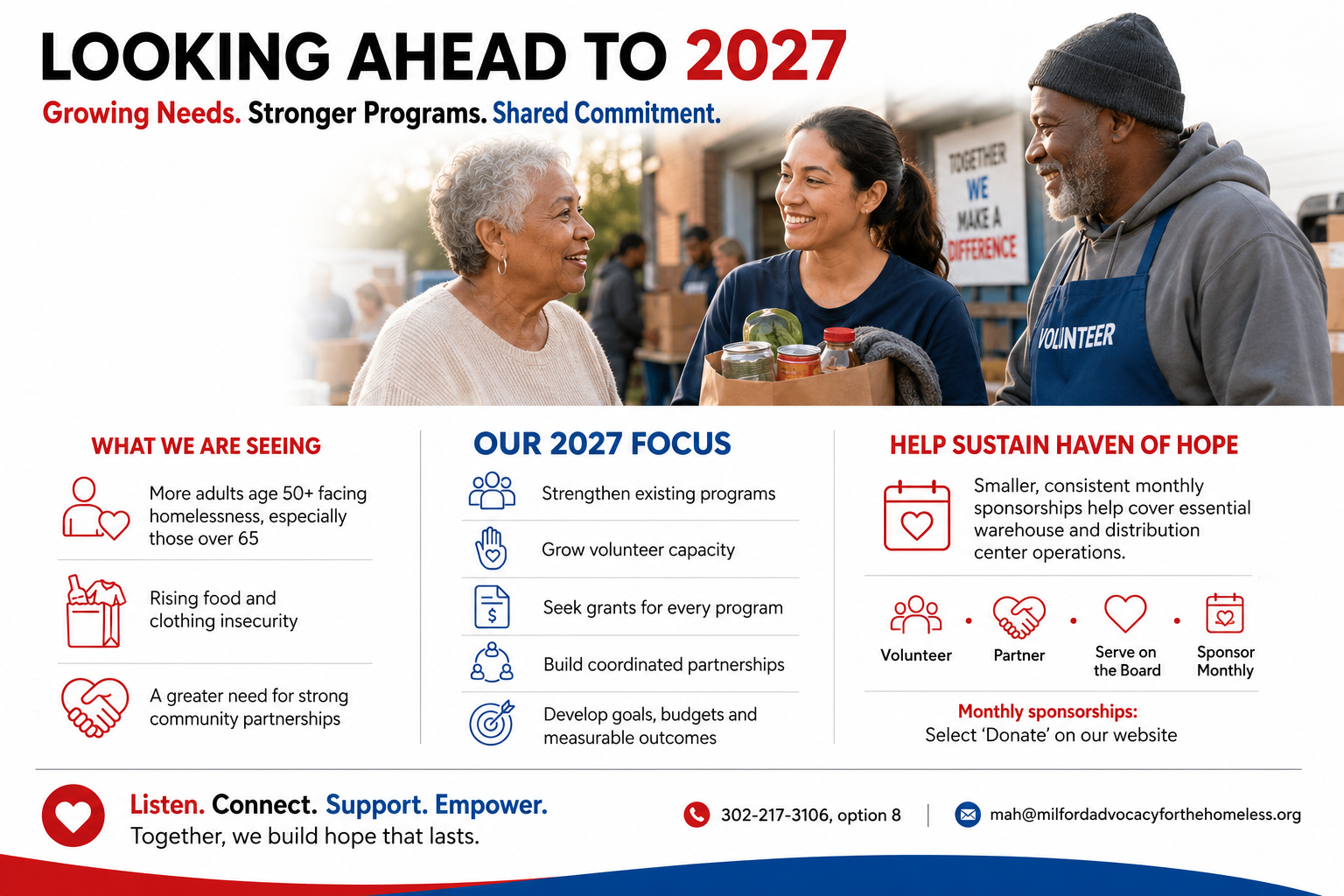
On Saturday, August 22, Milford Advocacy for the Homeless held its 2027 Strategic Board Meeting. Together, our Board of Directors reviewed MAH’s 2025 Impact Report, compared those results with today’s needs, and began identifying the priorities that will guide our work in 2027.
The numbers tell an important story, but behind every number is a person.
It is the older adult trying to survive on a fixed income after rent increases. It is the working parent choosing between groceries and a utility bill. It is the family whose children have outgrown their clothes but who cannot afford replacements. It is the neighbor sleeping in a vehicle who needs food that can be safely stored without a refrigerator.
These are not isolated situations. They reflect significant changes in our community.
What We Are Seeing in Our Community
As we reviewed our programs, services, and current impact, three emerging trends became clear:
- More adults age 50 and older are experiencing homelessness and housing instability, especially adults over age 65.
- Stronger partnerships are needed so organizations can coordinate services and respond more effectively.
- Food and clothing insecurity are increasing among individuals, families, seniors, and working households.
These changes will shape how MAH strengthens its current programs, builds partnerships, recruits volunteers, seeks funding, and measures impact throughout 2027.
More Older Adults Are Experiencing Homelessness
Imagine reaching retirement age and discovering that your monthly income is no longer enough to cover rent, utilities, medications, food, and transportation.
For a growing number of older adults, this is not a hypothetical situation. It is their daily reality.
Some are living in vehicles, temporary rooms, unsafe housing, or places not meant for habitation. Others remain housed but are only one unexpected expense away from losing the place they call home. A medical emergency, rent increase, vehicle repair, or loss of a family caregiver can quickly turn housing insecurity into homelessness.
We are especially concerned about the increase among adults over age 65. Many have worked throughout their lives but now find themselves trying to survive on limited or fixed incomes while the cost of necessities continues to rise.
For these neighbors, assistance may begin with food, clothing, transportation, identification, or help connecting with another organization. What matters most is that someone listens, recognizes the urgency of the situation, and helps them take the next step.
MAH will continue to:
- Meet older adults where they are.
- Treat every person with dignity and respect.
- Connect seniors with available community resources.
- Identify gaps that place older adults at greater risk.
- Advocate for stronger housing and support options.
- Walk alongside each person as they work toward greater stability.
Stronger Partnerships Are Essential
A neighbor rarely arrives with only one need.
A person seeking food may also need transportation to a medical appointment. A family requesting clothing may be struggling with housing costs. An older adult needing identification may also need help accessing benefits, healthcare, or safe housing.
MAH may be able to meet one part of the need, while another organization may be better equipped to provide specialized support. The difference between receiving a list of phone numbers and making a successful connection can determine whether a neighbor receives help or continues navigating the crisis alone.
That is why strengthening partnerships will be a major priority for 2027.
We will work to build stronger connections among:
- Nonprofit and community organizations.
- Faith communities.
- Healthcare and behavioral health providers.
- Government agencies.
- Housing and human service providers.
- Local businesses and employers.
- Funders and community foundations.
- Volunteers and neighborhood leaders.
Strong partnerships help all of us understand which services are available, where gaps exist, and how we can make referrals more effective. They also reduce unnecessary duplication and allow limited community resources to reach more people.
No single organization can meet every need, but together we can create a stronger network of care.
Food and Clothing Insecurity Are Increasing
Consider a parent who has paid the rent and kept the lights on but has very little money left for groceries. The family may be housed, yet there is not enough food to last until the next paycheck.
Consider an older adult who needs warm clothing but must choose between purchasing a winter coat and paying for medication.
Consider a person starting a new job who has the desire to work but does not have appropriate clothing, reliable transportation, or basic hygiene supplies.
These stories show why food and clothing insecurity cannot be measured only by whether someone has a roof over their head. Many housed neighbors are struggling to afford the essential items needed to remain healthy, employed, and stable.
We are seeing increased requests for:
- Food and prepared meals.
- Seasonal clothing and shoes.
- Hygiene products.
- Cleaning supplies.
- Household essentials.
- Work clothing.
- Transportation assistance.
- Emergency support.
Some of the people seeking assistance are living outdoors, in tents, in vehicles, or in temporary arrangements. Others are seniors, working adults, and families who have housing but do not have enough income to cover all of their basic needs.
Behind every request is a person trying to make it through a difficult season. Our responsibility is to respond with compassion, practical assistance, and respect.
Volunteers Make the Work Possible
Our volunteer community continues to grow, and we are deeply grateful for every person who gives their time, skills, resources, and heart to this work.
A volunteer might spend an hour picking up donated clothing from one of our drop-off locations. Another might sort and organize those donations at Haven of Hope. Someone else may fill a request, prepare food, repair a bicycle, deliver household items, provide transportation, or follow up with a neighbor.
Each task may feel small on its own. Together, those acts of service create a pathway to hope.
However, the growth in community need is outpacing the number of volunteers available to provide services. As more requests are received, more people are needed to complete the work behind every response.
Volunteers help MAH:
- Collect, sort, and organize donations.
- Prepare meals and food assistance.
- Fill clothing, hygiene, and household requests.
- Pick up and deliver donated items.
- Repair and distribute bicycles.
- Provide transportation.
- Support community outreach activities.
- Assist neighbors with forms and resource navigation.
- Complete administrative and data-tracking work.
- Build relationships through consistent follow-up.
Without enough volunteers, donated resources cannot move from the community into the hands of the people who need them. Volunteers are the connection between generosity and impact.
Strengthening Our Current Programs
MAH will not add new programs in 2027.
This is an intentional decision. Our goal is not simply to increase the number of programs we offer. Our goal is to strengthen the programs our neighbors already depend upon and ensure they are consistent, sustainable, measurable, and supported by the volunteers and resources needed to operate effectively.
During 2027, we will focus on:
- Improving coordination among MAH programs.
- Creating consistent intake, referral, and follow-up processes.
- Defining volunteer and leadership roles.
- Strengthening volunteer training and retention.
- Building stronger community partnerships.
- Tracking services, outcomes, and emerging needs.
- Improving response times and fulfillment rates.
- Protecting neighbor dignity, privacy, and confidentiality.
- Developing sustainable program budgets.
- Sharing stories that demonstrate community impact.
This approach will allow MAH to serve more responsibly while protecting the quality and dignity of every interaction.
Building Sustainable Support for Our Programs
We have worked hard to secure grants that help cover many of the start-up and service costs associated with our programs. Grant funding has helped MAH purchase equipment, provide direct assistance, strengthen services, and develop the resources needed to respond to our neighbors.
In 2027, we will continue seeking grant opportunities for each of our existing programs.
We will pursue grants that:
- Align with our mission and values.
- Strengthen services already provided by MAH.
- Address clearly identified community needs.
- Improve volunteer and operational capacity.
- Support collaboration with community partners.
- Produce meaningful and measurable outcomes.
- Preserve the dignity and privacy of the neighbors we serve.
We will not create programs simply because grant funding is available. Instead, we will seek funding that supports the work our community already needs and helps our established programs become stronger.
Grants, however, do not always cover the routine operational expenses required to keep services available throughout the year.
At Haven of Hope, our warehouse and distribution center, volunteers receive and organize donations, prepare food and hygiene resources, fill clothing and household requests, repair bicycles, coordinate deliveries, and bring our programs together in one shared space.
When someone receives a winter coat, a bag of food, a repaired bicycle, or household supplies, there is an entire network of activity behind that moment. The lights must be on. The building must be safe. Shelves, equipment, internet, insurance, cleaning supplies, and other operational necessities must be maintained.
These expenses may not be visible in the final act of service, but they make that service possible.
This is why MAH will place a gentle but intentional focus on monthly sponsorships in 2027. We will invite community members who are able to support us financially to consider making a smaller, consistent monthly contribution toward the operational expenses of Haven of Hope.
Monthly sponsorships can help support:
- Rent and utilities.
- Insurance and facility expenses.
- Internet and telephone services.
- Cleaning and warehouse supplies.
- Equipment maintenance.
- Program administration.
- Other routine operational needs.
A monthly sponsorship does not need to be large to make a meaningful difference. When several people give a manageable amount each month, those contributions create dependable support that helps MAH plan responsibly and keep Haven of Hope ready to serve.
Just as one volunteer hour, one donated coat, or one prepared meal becomes part of something larger, every monthly sponsorship contributes to a stronger foundation for service.
Those interested in becoming monthly sponsors can visit our website and select “Donate” from the menu. There is no expectation that everyone can give financially. Some support with their time, some share resources, some open doors to partnerships, and some help through consistent financial sponsorship. Each form of support matters.
Preparing Our 2027 Goals and Budgets
Throughout the next several months, the Board and leadership team will actively develop MAH’s 2027 goals, priorities, program budgets, and measures of success.
This work will help us answer several important questions:
- Who is seeking help, and how are their needs changing?
- Which services are being requested most often?
- Where are the greatest gaps in our community?
- What resources does each program need to operate successfully?
- How many volunteers are needed to meet the growing demand?
- Which partnerships should be strengthened?
- What outcomes will show that our work is creating meaningful impact?
- Which grants and funding relationships align with our priorities?
- What level of monthly sponsorship is needed to sustain Haven of Hope?
Our strategic direction will remain centered on four actions:
Listen. Connect. Support. Empower.
We will listen first, connect neighbors with appropriate resources, provide support when gaps exist, and walk alongside people as they work toward greater stability.
Preparing for Board Leadership Transitions
Several longtime Board members will complete their terms this year. Some will be stepping down as they enter retirement or experience other life changes.
We are grateful for their years of service, leadership, and commitment to MAH. Their contributions have helped establish programs, build partnerships, guide responsible decisions, and create the foundation upon which MAH continues to grow.
As these leaders begin a new chapter, MAH will be seeking individuals to serve in two important roles:
- Board members: Voting members who provide governance, fiscal oversight, strategic direction, accountability, and community leadership.
- Associate board members: Non-voting members who contribute their experience, ideas, connections, and support while learning more about MAH’s mission and Board service.
We are looking for individuals who believe in servant leadership, collaboration, responsible stewardship, and treating every person with dignity and respect.
Experience in the following areas would be especially valuable:
- Finance and budgeting.
- Fundraising and grant development.
- Nonprofit governance.
- Community partnerships.
- Housing and human services.
- Healthcare and behavioral health.
- Communications and marketing.
- Technology and data management.
- Volunteer leadership.
- Business and organizational development.
Board service is more than attending meetings. It is an opportunity to help guide an organization that is responding to real and growing needs within our community.
Hope Lives Here
Our strategic meeting was not simply about reviewing reports or building a plan. It was about the people represented within every number.
It was about the senior wondering where they will sleep next month. It was about the parent stretching a small amount of food until payday. It was about the volunteer who shows up after a full day of work because someone in the community needs help. It was about the partner organization that answers the phone and helps complete the next step. It was also about the monthly sponsor whose consistent contribution quietly helps keep Haven of Hope open and ready for all of them.
Hope is more than providing a resource.
Hope begins when someone listens.
Hope grows when a neighbor is connected to the right support.
Hope becomes stronger when a person knows they do not have to navigate difficult circumstances alone.
Rooted in dignity, compassion, and service, MAH will continue meeting people where they are and walking alongside them as they rebuild their lives.
Together, we can build hope that lasts.
To learn more about volunteering, partnership opportunities, monthly sponsorships, grant support, or serving as a Board or associate board member, contact Milford Advocacy for the Homeless at 302-217-3106, option 8, or email mah@milfordadvocacyforthehomeless.org. Monthly sponsorships can also be established by selecting “Donate” from the menu on our website.
 Facebook
 Twitter
 Linkedin

