
Every year on September 10, World Suicide Prevention Day reminds us of something that can be easy to forget in the middle of everyday life: the person who is struggling may not look like they are struggling at all.
They may be the coworker who shows up every morning. The parent sitting beside you at a school event. The friend who makes everyone laugh. The senior living quietly down the street. The person volunteering beside you. They may look like you. They may look like me. There is not always an obvious outward sign that someone is living with depression, emotional pain, or thoughts of suicide. That is why simply noticing one another, staying connected, and being willing to ask a caring question can matter so much.
Mental health challenges touch millions of families across the United States. According to the 2024 National Survey on Drug Use and Health, 23.4% of U.S. adults experienced some form of mental illness during the previous year, nearly one in every four adults. Another 14.6 million adults experienced a serious mental illness that substantially affected their daily lives.
Depression is also incredibly common. CDC data shows that approximately 1 in 5 adults has been told by a healthcare professional that they have a depressive disorder. Among high school students, 2 in 5 reported experiencing symptoms of depression, including feeling persistently sad or hopeless enough that they stopped doing some of their usual activities. And behind those numbers are people experiencing some of their darkest moments.
In 2024, an estimated 14.3 million adults seriously considered suicide. Approximately 4.6 million made a suicide plan, and 2.2 million attempted suicide. That same year, 48,824 people died by suicide in the United States. Those aren’t simply statistics. They are parents, children, grandparents, friends, neighbors, and coworkers.
Someone Who Is Struggling Can Look Just Like You and Me
It is tempting to believe we would know if someone close to us were considering suicide.
Sometimes there are changes we can notice. Other times, there may be very little that is visible from the outside. Mental illness and suicidal thoughts are deeply personal experiences, and someone can continue working, caring for their family, smiling in photographs, attending church, volunteering, or joking with friends while carrying tremendous pain privately.
Suicide also cannot be explained by one diagnosis or one circumstance. CDC notes that suicide is influenced by many different factors, and not everyone who dies by suicide has a known diagnosed mental health condition.
That makes human connection especially important. We do not have to diagnose someone. We do not have to know exactly what to say. We simply need to be willing to notice, listen, and stay present.
Three Simple Things You Can Do Today
1. Check in with someone you have not heard from lately.
Send the text. Make the call. Knock on the door. Instead of only asking, “How are you?” try something a little more personal: “I’ve been thinking about you. How are things really going?”
2. Give someone your full attention.
Sometimes the greatest gift we can offer is a few minutes without distractions, advice, or judgment. Listen. Allow silence. Let the person know they do not have to pretend everything is okay with you.
3. Ask again.
Someone may automatically respond, “I’m fine.” If your instincts tell you something feels different, check in again. Tell them they matter to you. If you are concerned they may be thinking about suicide, it is okay to ask directly and help them connect with crisis support.
Connection is a protective factor. CDC identifies connection to family and community support as one of the factors that can help reduce suicidal thoughts and behaviors.
Help Is Available
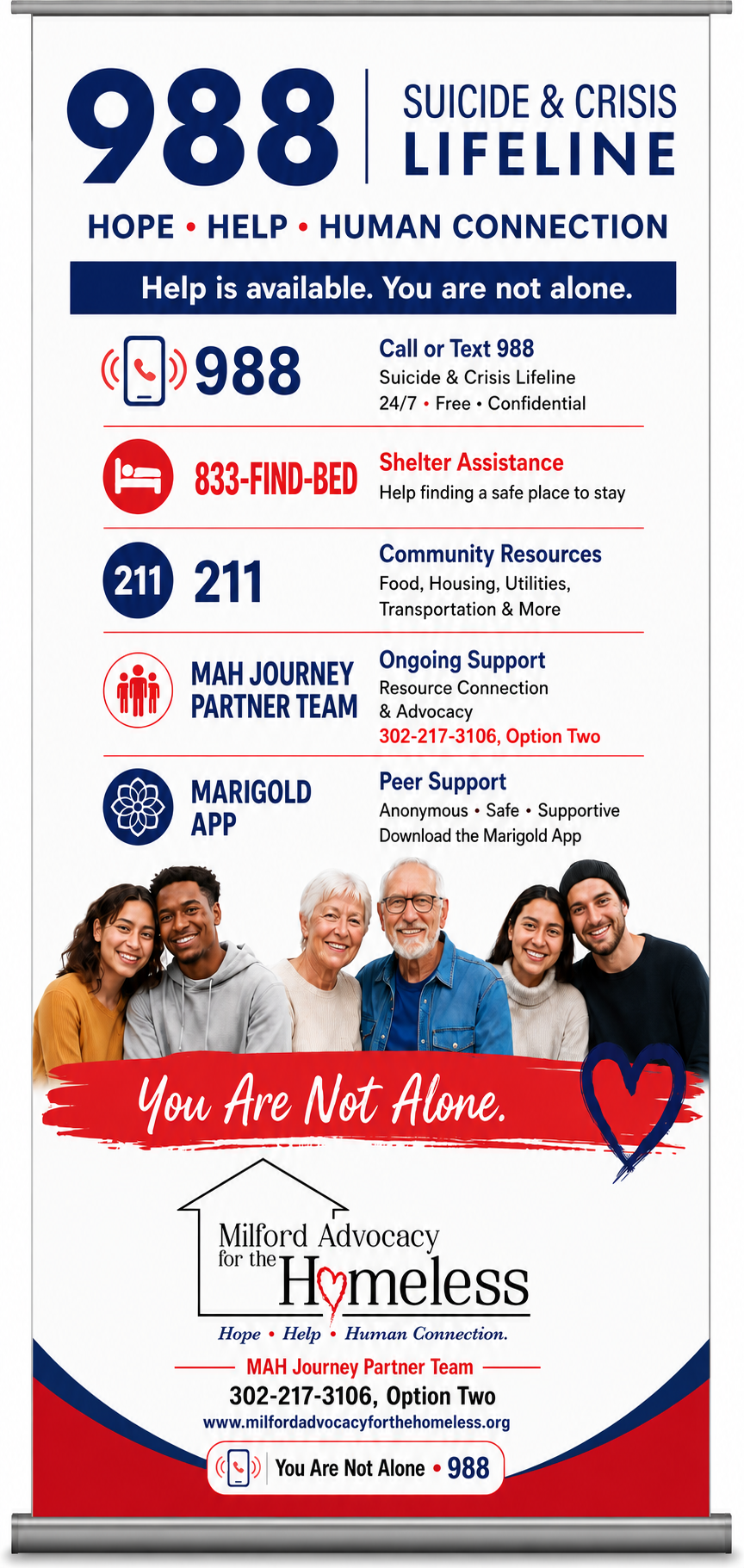
No one needs to face a crisis alone. The resources shared in our World Suicide Prevention Day graphic provide several places to begin:
988 Suicide & Crisis Lifeline: Call or text 988 for free, confidential crisis support, 24 hours a day, 7 days a week. Since the national 988 service launched in July 2022, the Lifeline has answered more than 13 million calls, texts, and chats from people seeking support. You do not have to provide personal identifying information to receive help.
Shelter Assistance: Call or text 1-833-FIND-BED (1-833-346-3233) to reach Delaware’s Centralized Intake system for information and referrals to emergency shelter openings and housing assistance. Centralized Intake operates Monday through Friday from 8:00 a.m. to 5:00 p.m.
Delaware 211: Dial 211 for connections to food, housing, utilities, transportation, and other community resources.
MAH Journey Partner Team: Call 302-217-3106, Option 2 for ongoing resource connection and advocacy. Sometimes the next step is simply having someone willing to walk alongside you.
Marigold Health: The Marigold app provides an anonymous community where people experiencing mental health and substance-use challenges can connect with others for peer support. It is an ongoing peer-support resource, not an emergency crisis service. Anyone experiencing an immediate crisis should call or text 988.
Check In.
Listen.
Connect.
World Suicide Prevention Day is not only about talking about suicide. It is about creating communities where people know they matter before they reach their darkest moment.
At Milford Advocacy for the Homeless, we believe in meeting people where they are and walking alongside them with dignity, compassion and service. Sometimes that means helping someone find housing or food. Sometimes it means connecting them with resources. And sometimes it simply means reminding another human being:
I see you. I am here. You do not have to carry this alone.
Today, think of three people.
Send the text.
Make the call.
Have the conversation.
You may never know how much that moment of loving-kindness mattered.
Help is available. You are not alone.
 Facebook
 Twitter
 Linkedin


